256px.webp)
Before Your Council Asks What Cameras Cost, Know What Not Having Them Already Costs You
Before Your Council Asks What Cameras Cost, Know What Not Having Them Already Costs You
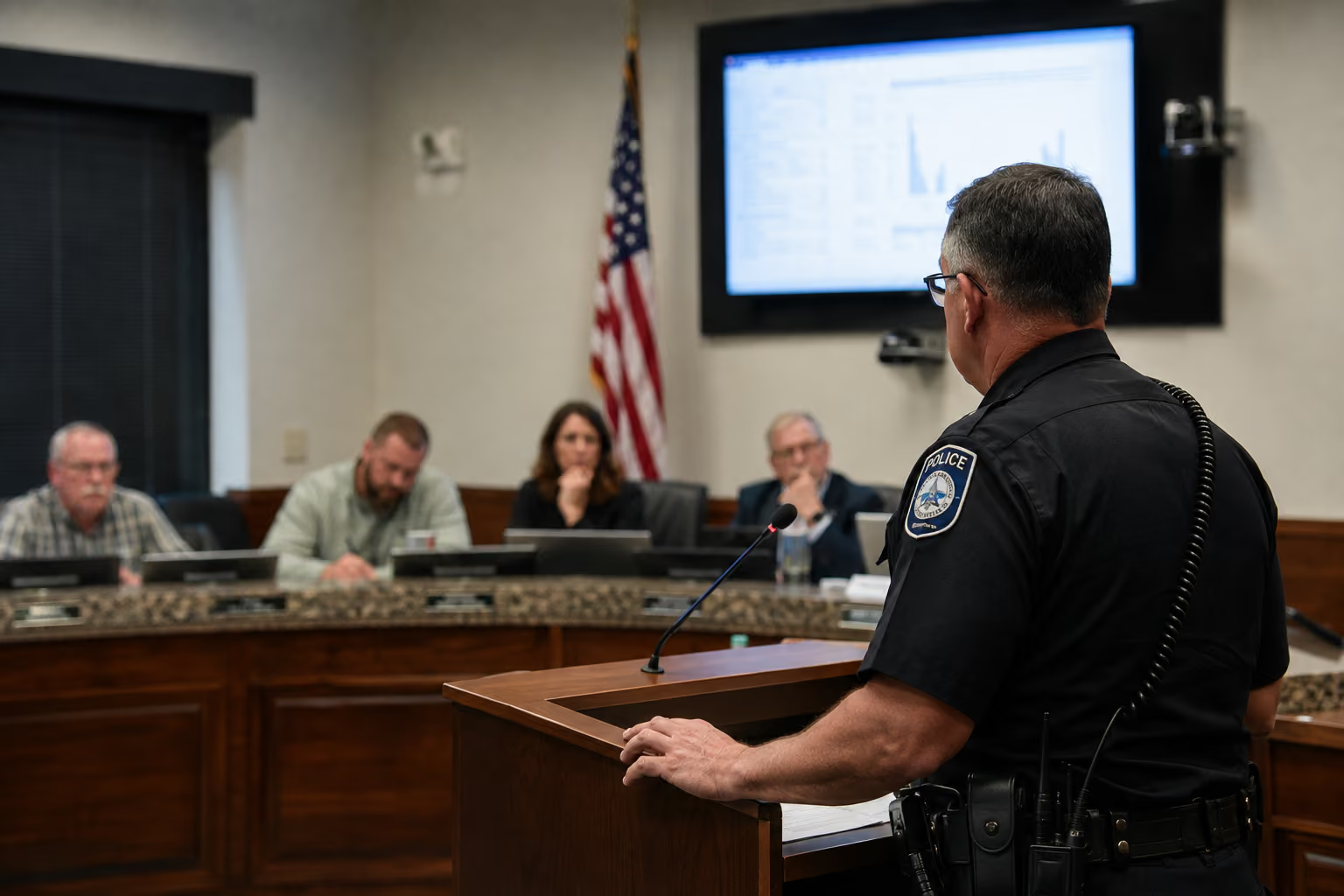
Your town council, county board, or city manager is going to look at the price of a body camera contract and ask one question: what does this cost us?
That's the wrong question, and it's your job to change it.
The right question is what it's already costing you not to have cameras. That number is harder to see because it doesn't show up on a purchase order. It shows up as a $50,000 deductible on a disputed complaint your insurer decides to settle. It shows up as weeks of supervisor time on an investigation that video would have closed in an afternoon. It shows up as an officer who leaves the profession because no one could prove what actually happened. None of it appears on a budget line until it's too late to avoid it.
What a Single Complaint Actually Costs
Chief Mark Swistek has taken a body camera proposal to his governing body twice and won both times. He runs the Long Beach (IN) Police Department, a five-person agency, and previously served as Chief at Michigan City. The argument that landed was not about the technology. It was about the deductible.

"You may have a $50,000 deductible. If you can't back up the simplest complaint or excessive use of force, a lot of times your insurer is going to say, go ahead and we're going to settle this first $50,000. On small communities like us, that can really hurt a budget."— Chief Mark Swistek, Long Beach (IN) Police Department
That $50,000 is not illustrative. It is the actual deductible Swistek's agency carries before its insurer steps in. It is also, for most lean departments, more than the cost of a full year of a body camera program. One complaint. One settlement. More than a year of cameras. That is the comparison your council needs to hear, and it is the comparison that changes the conversation.
The Cost That Never Appears on a Budget Line
Chief Lesley Wiete has led Purdue University Police for nearly 27 years. Her department covers 45 sworn officers and 55,000 people on campus, with roughly the officer-to-population ratio of a department running well below recommended staffing. She knows what it means to absorb a crisis without backup.
Shortly after implementing body cameras, her department faced a use-of-force complaint that went national. Before a single frame of footage was reviewed, the university's executive leadership was ready to terminate the officer involved. Wiete pushed back.

"A lot of the executive leadership at the time were ready to fire the officer without having any knowledge or hearing his side of it. I do 100% believe having those body cameras saved that officer's job in the long runbecause he did not do anything wrong"— Chief Lesley Wiete, Purdue University Police Department
That officer is now a sergeant.
The cost of losing him never appeared on a budget line. But it was real. The investigation, the legal exposure, the morale hit to every officer watching to see whether the department would stand behind its people, the damage to the agency's credibility with the community, none of that is hypothetical. For a 45-officer department with no room to absorb it, it is the kind of event that defines a chief's tenure.
What the Research Actually Shows
The following figures replace the aggregator statistics used in an earlier draft of this piece. Each one now traces to a named, checkable study rather than a market-research roundup.
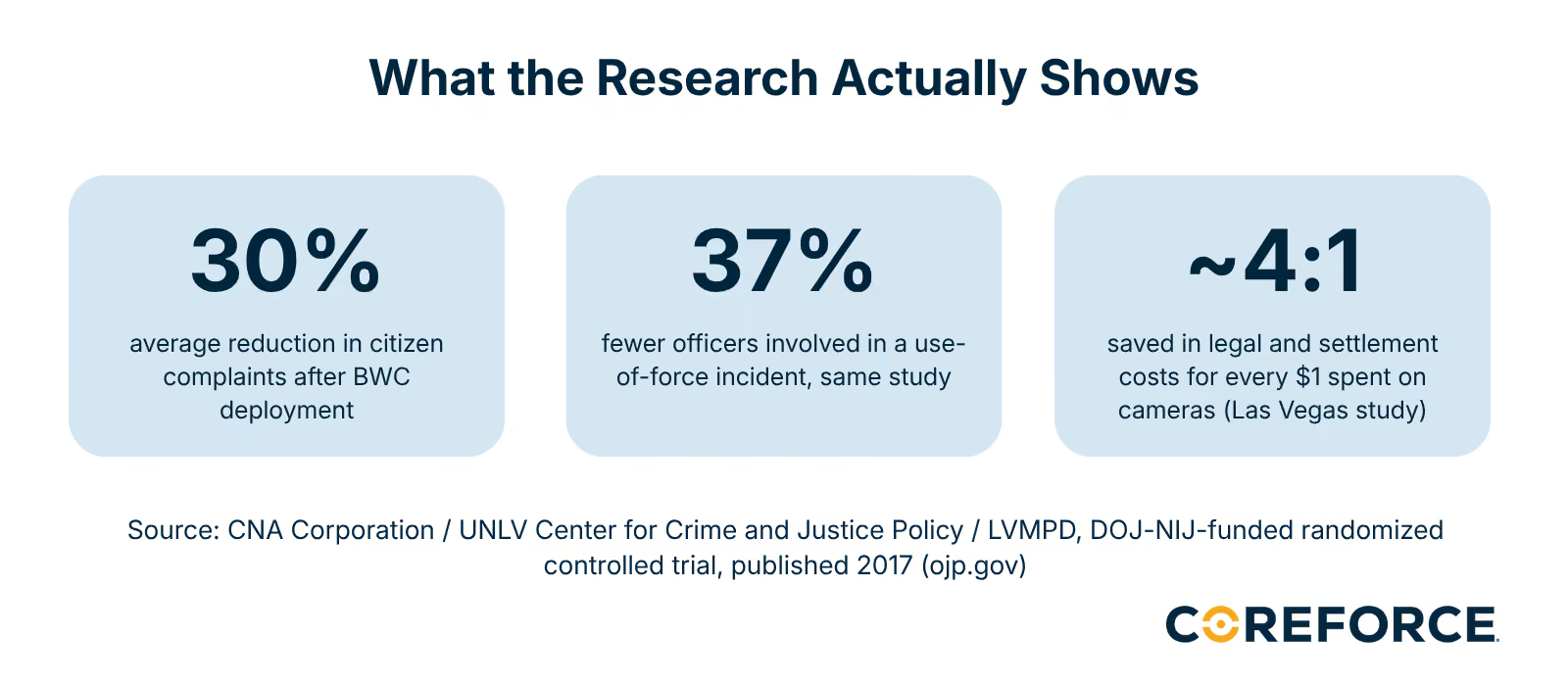
• In a Department of Justice / National Institute of Justice-funded randomized controlled trial of 400 body-camera-equipped officers against a 400-officer control group, the Las Vegas Metropolitan Police Department saw a 30% decrease in officers with at least one misconduct complaint filed against them, and a 37% reduction in officers involved in a use-of-force incident.
• The same study found that a misconduct complaint without body-camera footage took an average of 91 personnel hours and cost $6,776 to investigate, versus 7.33 hours and $554 with footage — an estimated $4,006 avoided in investigation costs per camera-equipped officer per year, against a program cost of $828 to $1,097 per officer per year. Roughly a 4-to-1 return, documented rather than estimated.
• In a survey of prosecutors, 96% said video evidence improved their ability to prosecute cases, and in a separate survey of lead prosecutors, 62.7% believed body camera evidence would help the prosecution more than the defense.
Worth noting in the interest of giving your council the full picture: this Las Vegas result was notably stronger than comparable studies in Washington, D.C., Phoenix, and Edmonton, which found no statistically significant effect on misconduct. The case for cameras rests on the strongest documented result available, not a universal guarantee.
Sources
[1] CNA Corporation / UNLV Center for Crime and Justice Policy / Las Vegas Metropolitan Police Department — “Body-Worn Cameras: Assessing the Evidence,” DOJ-NIJ-funded randomized controlled trial, published 2017 https://www.ojp.gov/pdffiles1/nij/grants/251416.pdf
[2] Harvard Law Review, “Considering Police Body Cameras,” Vol. 128, citing a survey of prosecutors on the evidentiary value of body camera footage https://harvardlawreview.org/print/vol-128/considering-police-body-cameras/
[3] Body Camera Technology for Any Size Agency: Without Adding Staff or Regret
Webinar Transcript — Chief Mark Swistek, Chief Lesley Wiete, 2026
Two chiefs who've already been through this
Chief Swistek and Chief Wiete share what they got wrong the first time and what they'd do differently if they were starting a body camera program today. If you're the one who'll have to answer for this rollout down the road, it's worth watching before you commit to anything. Free, on demand.
The real cost of skipping body cameras isn't on any budget line, until a $50,000 complaint shows up.
See what a body camera program looks like for your agency
The numbers in this piece are real, but they're Swistek's. Talk to Coreforce and get a clear picture of what a program looks like for an agency your size, and what it actually costs. If budget is the real hold-up, ask about financing through Lexipol, and Coreforce can also help you find grants your agency may qualify for.