256px.webp)
There's a Grant for That: How Lean Agencies Are Getting Body Cameras Funded
Ask a group of small-agency chiefs why they haven't moved on body cameras yet, and cost comes up almost every time. What almost never comes up is the next logical question: have you actually looked at what's available to fund it?
For most small departments, the honest answer is no. Not because the money isn't there, but because the grant process has a reputation for being complicated, slow, and built for agencies with a full-time grants administrator on staff. That reputation is outdated. Federal funding specifically designed for agencies like yours has been available for years, and the FY2026 cycle has more of it than in recent memory.
Here is what is actually available right now, and what it would take to apply.
What's Already Been Funded
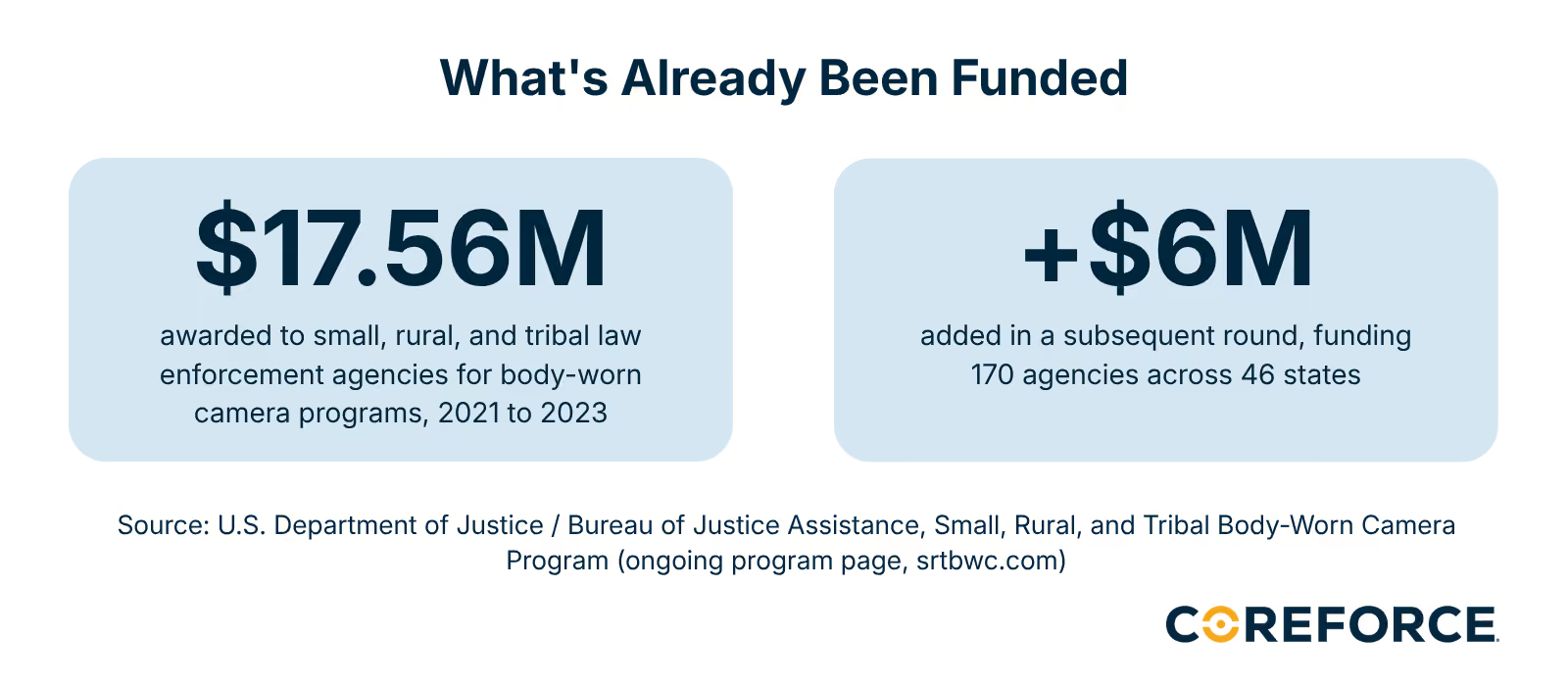
Before getting into the specific programs, one number is worth anchoring on: from 2021 through 2023 alone, the Bureau of Justice Assistance awarded more than $17.56 million to small, rural, and tribal agencies for body-worn camera programs. A subsequent round added another $6 million, funding 170 agencies across 46 states. That is not a hypothetical pool of money. It is money that has already gone out the door to departments that look a lot like yours.
Byrne JAG: The Workhorse Grant Most Agencies Already Qualify For
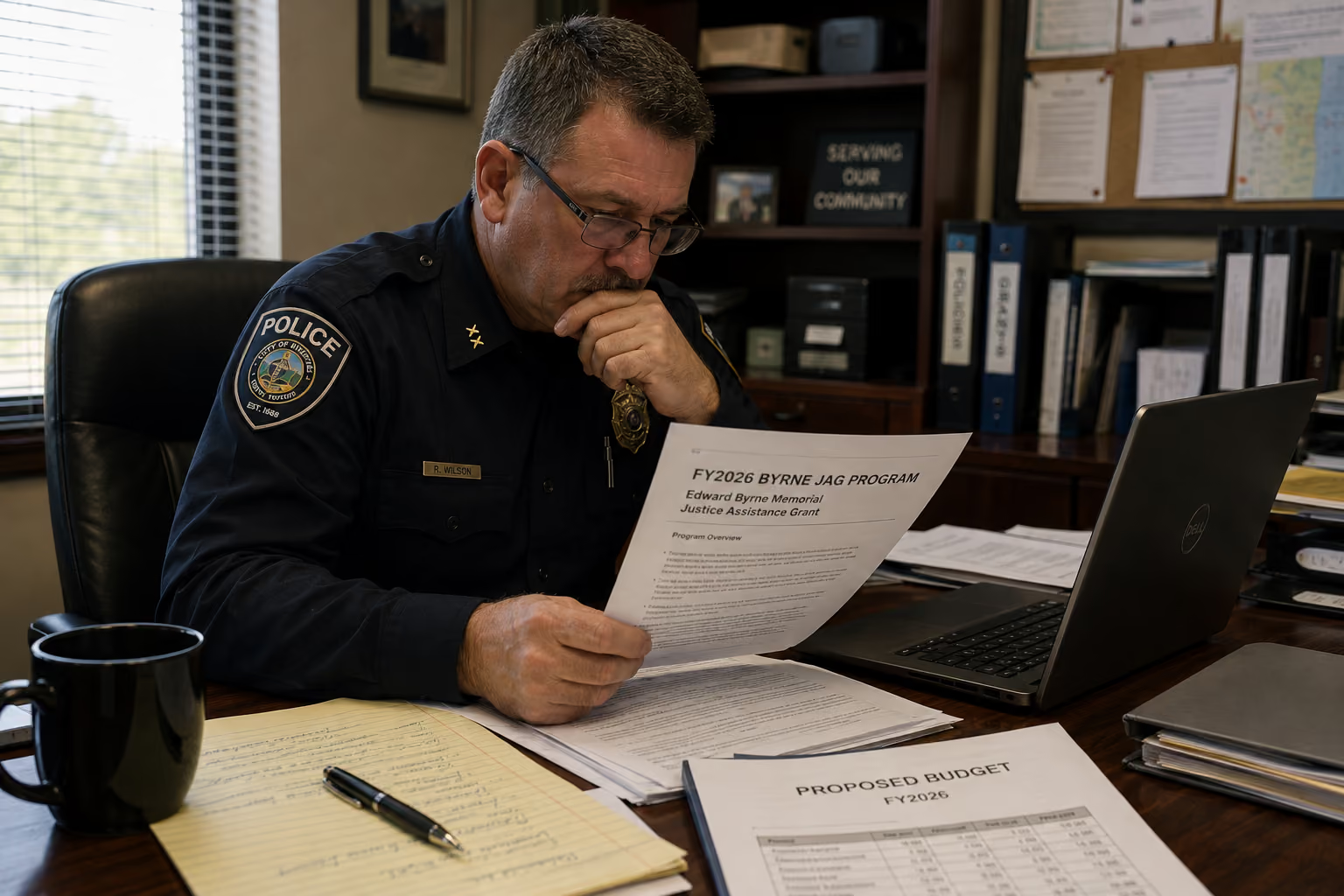
The Edward Byrne Memorial Justice Assistance Grant, known as Byrne JAG, is the largest and most flexible source of federal justice funding to state and local agencies. It funds a broad range of law enforcement technology including body-worn cameras, and is explicitly designed to give agencies flexibility to address their most critical resource gaps.
- For FY2026, Congress appropriated $964 million in total JAG funding, the highest level in the program's history, though this top-line figure includes numerous congressional set-asides for other programs.
- There is no local match requirement, and eligibility includes city and county law enforcement agencies of virtually any size.
- Smaller agencies typically apply through state-level pass-through solicitations rather than direct local formula allocations, since Byrne JAG funds are allocated to states and then sub-granted to local units.
- The BWC-specific portion of JAG is no longer a straight equipment grant. It must be built around a program that includes policy development and training, which works in smaller agencies' favor since a well-designed program proposal from a chief who knows their community is more competitive than a boilerplate equipment request from a large department.
DOJ Micro-Grants: Built Specifically for Departments Like Yours
If your department has 50 or fewer sworn officers, you may be eligible for the DOJ's micro-grant program, which is specifically designed for small, rural, and tribal agencies and has no eligibility requirement to be named in a Congressional document.
- The $6 million round broke down to 112 small towns, 40 county sheriff's and county police agencies, 12 federally recognized tribal law enforcement agencies, and six university and technical school law enforcement agencies across 46 states.
- The program is funded through a competitive microgrant solicitation open to any law enforcement department with 50 or fewer full-time sworn personnel, rural agencies, and federally recognized tribal agencies, with a recent solicitation releasing $7.65 million.
The DOJ Body-Worn Camera Policy and Implementation Program
The DOJ's Bureau of Justice Assistance also operates the Body-Worn Camera Policy and Implementation Program (BWCPIP), a grant specifically designed to help law enforcement agencies establish or expand body-worn camera programs. The FY2025 solicitation supported agencies in purchasing equipment, developing policy, and training officers.
The COPS Office Technology and Equipment Program (TEP) is a third avenue, offering up to $401 million for FY2026. Unlike Byrne JAG, TEP is noncompetitive and invitational: eligible applicants are limited to those specifically named in that year's Congressional Joint Explanatory Statement. In practice, that means an agency typically needs its member of Congress to have already requested funding on its behalf. Worth knowing about, but not something most agencies can apply to on their own initiative the way they can with Byrne JAG or a state pass-through solicitation.
The Real Reason Small Agencies Don't Apply
It isn't that the money doesn't exist. It's that grant applications require a specific kind of writing, narrative justification, budget tables, outcome metrics, that most chiefs and department administrators have never been trained to produce, and frankly don't have time to learn while also running daily operations for a department with no dedicated grants staff.
That's the actual barrier, and it's also the easiest one to remove. Coreforce partners with Lexipol's grant writing team to help agencies identify and apply for federal and state funding that can offset some or all of a camera program's upfront cost, which means the budget objection and the liability exposure can often be solved in the same conversation.
Sources
[1] Congressional Research Service — “The Edward Byrne Memorial Justice Assistance Grant (JAG) Program”, FY2026 appropriations data https://www.congress.gov/crs-product/IF10691
[2] U.S. Department of Justice — “Justice Department to Provide Funding for Body-Worn Cameras to Small, Rural and Tribal Law Enforcement Agencies” (announcing the $7.65 million competitive microgrant solicitation) https://www.justice.gov/archives/opa/pr/justice-department-provide-funding-body-worn-cameras-small-rural-and-tribal-law-enforcement
[3] SRT BWC (Small, Rural, and Tribal Body-Worn Camera Program) — ongoing program page; reports $17.56 million awarded 2021–2023 plus a subsequent $6 million round to 170 agencies across 46 states https://www.srtbwc.com/
[4] Bureau of Justice Assistance — FY25 Body-Worn Camera Policy and Implementation Program to Support Law Enforcement Agencies https://bja.ojp.gov/funding/opportunities/o-bja-2025-172461
[5] Lexipol — “Navigating Grants for Body-Worn Camera Program Funding” https://www.lexipol.com/resources/blog/navigating-grants-for-body-worn-camera-program-funding/
[6] COPS Office — FY2026 Technology and Equipment Program (TEP) Notice of Funding Opportunity https://cops.usdoj.gov/tep
The grant gets you funded. This gets you ready.
Whether your agency funds this through a grant or your own budget, the rollout is a separate challenge. Chief Swistek and Chief Wiete talk through what they got wrong the first time and what they'd do differently now, no product demo, no sales pitch. Worth watching while your application is still in progress, not after the cameras arrive.
The money already exists. Most chiefs just haven't looked for it yet.
Find the grant that fits your agency
Byrne JAG, the SRT micro-grant program, BWCPIP, TEP, each has different eligibility rules, deadlines, and odds for an agency your size. Talk to Coreforce, and our team will help you match your agency to the program most likely to fund it, instead of you piecing that together across four separate solicitations on your own. If you want help writing the application itself, Lexipol's grant writing team can do that for a fee, and we'll make the introduction.