256px.webp)
Policy First, Camera Second: Why the Most Important Document in Your Body Camera Program Isn't a Camera

A body camera lawsuit can turn on footage that exists, captured exactly what happened, and still did not protect the agency. The officer stopped recording before the interaction concluded, or classified the footage incorrectly, or the department had no written policy saying either of those things was wrong.
A body camera without a policy does not give you a defensible record. It gives you documented evidence of inconsistency. Every officer making individual decisions about when to record, when to stop, and how to classify footage is creating a different operational standard on every shift. When that inconsistency shows up in a deposition, the question is not what the footage shows. It is why this officer's conduct was different from that officer's, and what policy your department had in place to prevent it.
The Bureau of Justice Assistance's Body-Worn Camera Toolkit makes the same point: most studies, and the leaders who have implemented programs, highlight the need for comprehensive written policies before a program launches. [3] Chief Wiete's answer to what keeps a program defensible under legal pressure is direct.
"That's where your policy comes into place. Having a solid policy written so the officers understand what the expectation is and what they're going to be held to. It also helps them be able to go down the steps of what they need to do to properly get their case approved, the body camera footage approved, and making sure they categorize correctly."
— Chief Lesley Wiete, Purdue University Police Department [6]
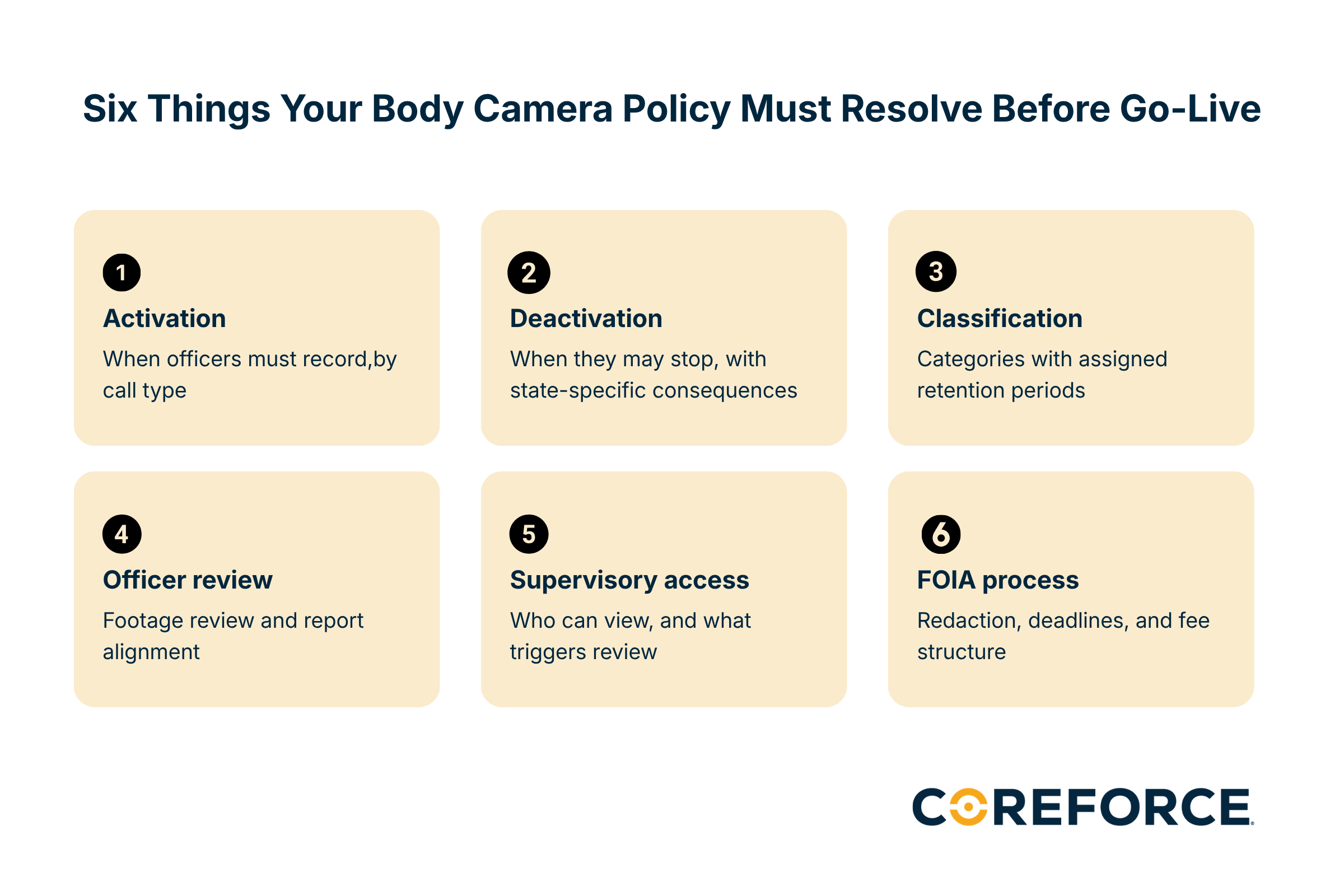
What a Body Camera Policy Has to Resolve Before Go-Live
Most agencies know they need a policy. Fewer know how many specific decisions it has to make before it is operational rather than a document sitting in a binder.
When officers must record.
Activation requirements need to be defined for every category your officers handle: calls for service, self-initiated stops, arrests, use of force, prisoner transport, and any other situation where a recording should exist. Does CAD activation satisfy the requirement for a dispatched call, or must the officer also confirm? Your policy needs to answer that before your first shift.
When officers may stop recording, and what happens if they do not.
This is where many small-agency policies have dangerous gaps. Victim privacy, undercover operations, sensitive locations like schools and hospitals, confidential informants, and private residences typically call for specific deactivation guidance. The legal stakes are not abstract. In Colorado, if an officer fails to activate a required camera or tampers with footage, a court or hearing may infer, in most investigations and legal proceedings, that the missing footage would have reflected misconduct. Criminal proceedings against the officer are excluded. [1] Indiana makes it a Class A misdemeanor for an officer to turn off or disable a camera, in violation of agency regulations or policy, with the intent to commit or conceal a criminal act. [2] Notice that Indiana's offense is defined by reference to your own agency's rules. Your written policy is part of the legal picture. A generic model policy will not reflect your state's requirements, and the liability of getting it wrong falls on your department.
Classification categories and retention periods.
Every piece of footage needs a classification that determines retention length and access rights. BJA's toolkit notes that many departments separate evidentiary from non-evidentiary video, with sub-categories by encounter type such as use of force or arrest, and set retention by classification. [4] Your policy must define those categories clearly enough that every officer classifies the same call the same way without interpretation. Your state's retention rules set the minimums. [5]
Officer review and report alignment.
Agencies differ on whether officers may review footage before writing a report, so your policy has to choose a rule. It also needs to say what officers must do if the footage contradicts their initial notes, and whether the report must record that footage was reviewed. These situations will happen in your first week of operations. Officers need to know the answers before that week starts.
Supervisory access and oversight.
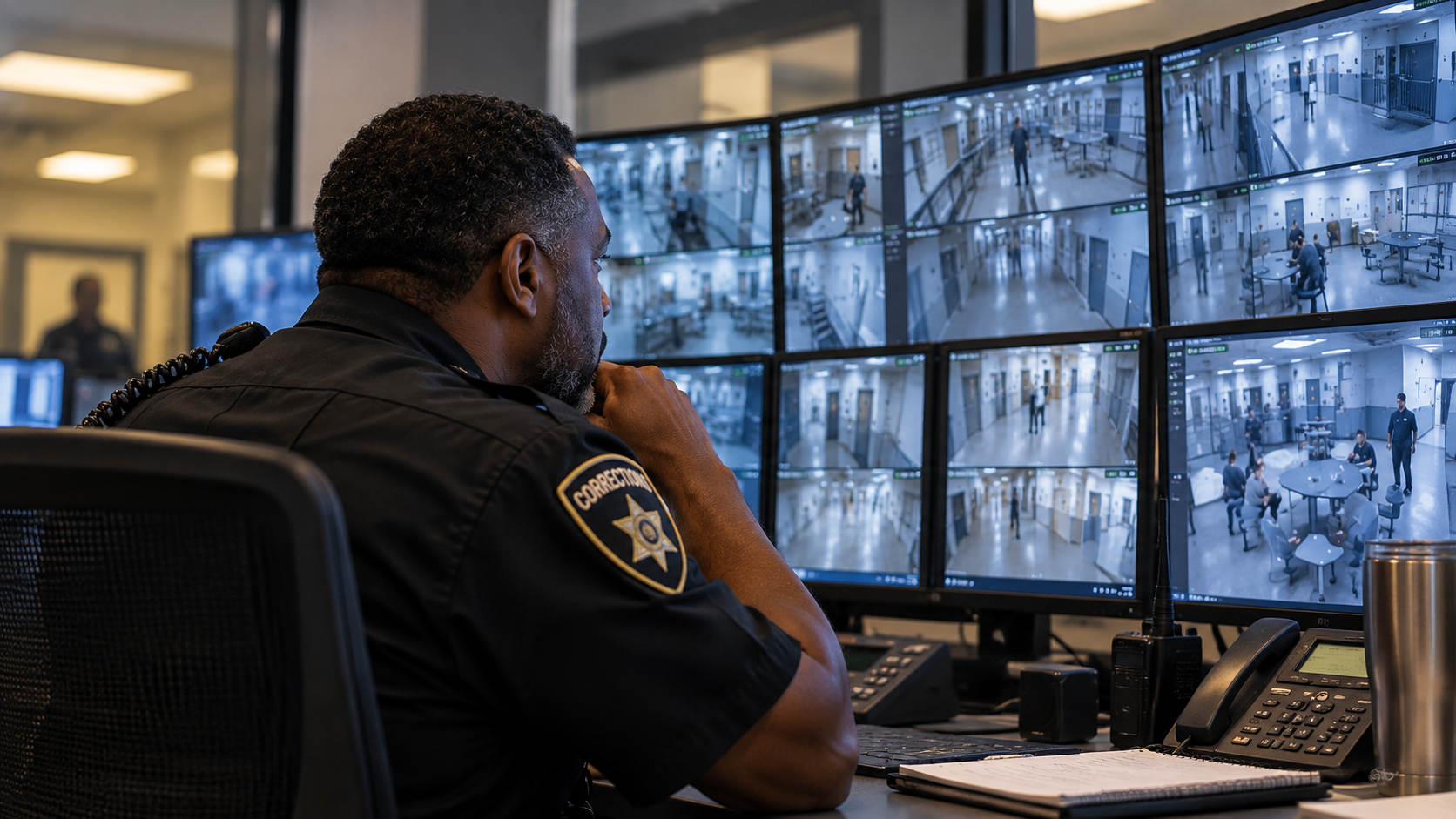
Who can access footage beyond the recording officer? What circumstances allow a supervisor to review footage proactively, outside of a formal complaint? What triggers a mandatory administrative review? These rules determine how accountability functions in your agency and how protected your officers are from unwarranted review. Both matter to your officers and to your union representative.
FOIA and public records process.
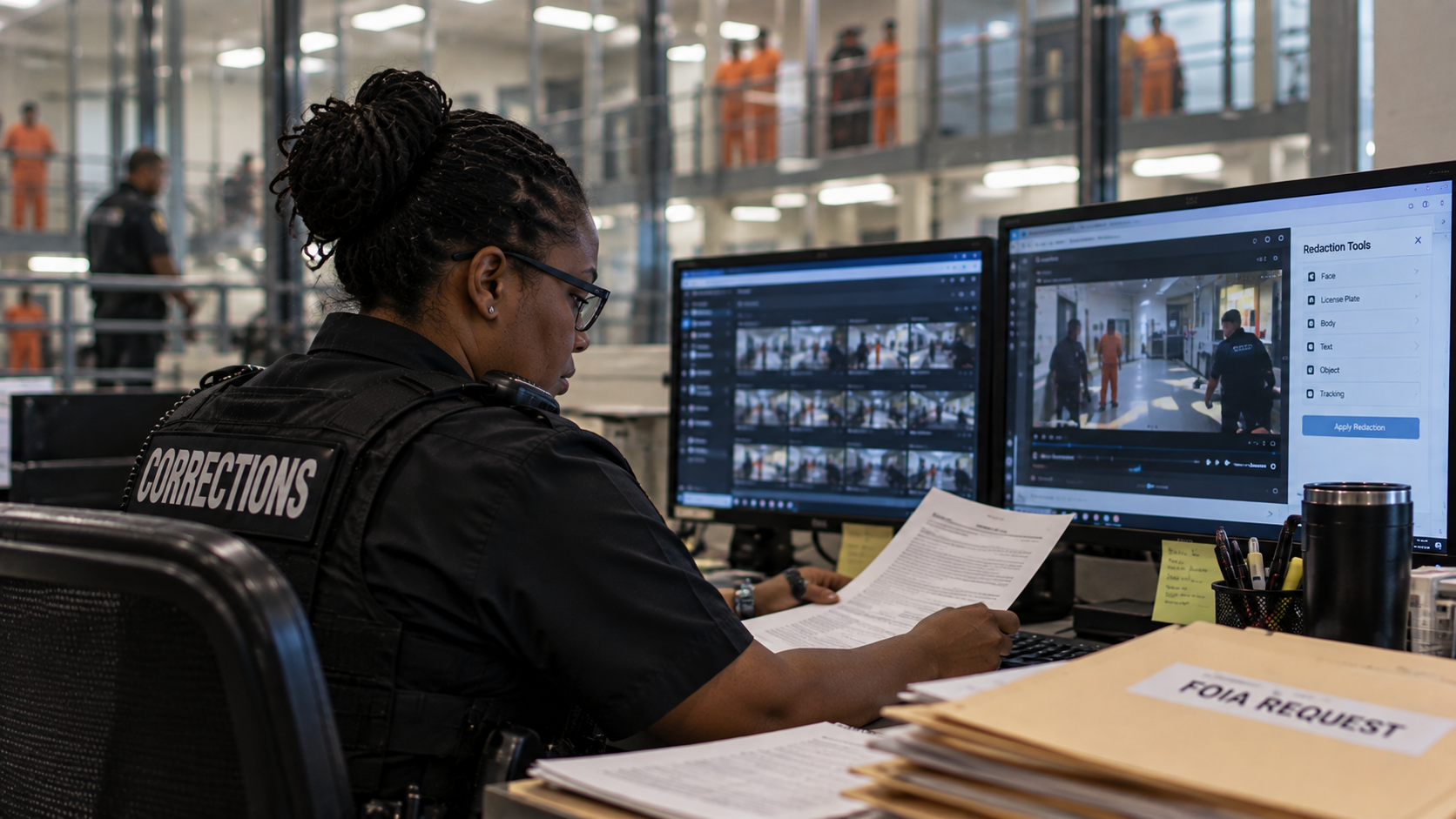
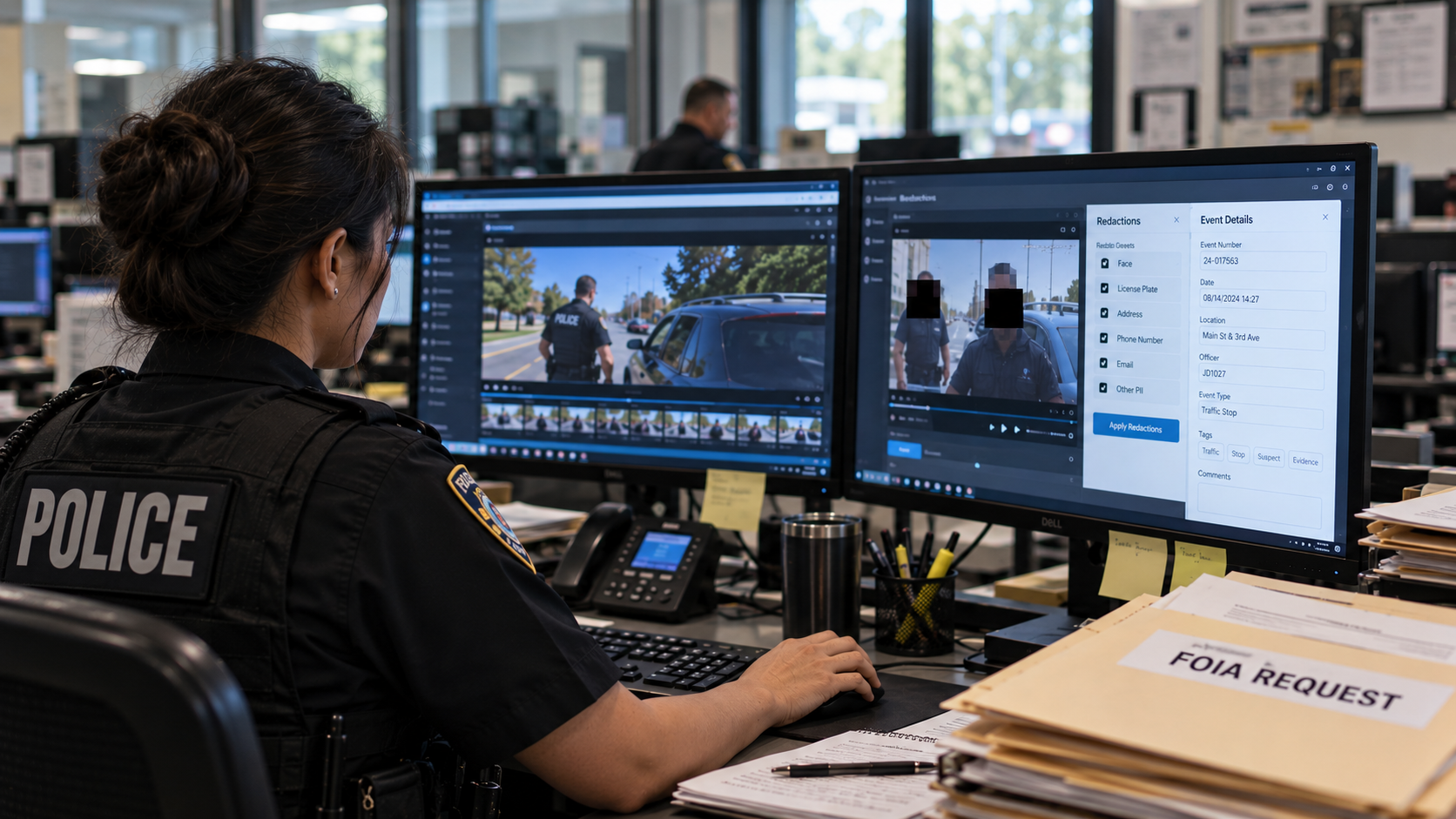
States differ on whether body camera footage is releasable at all, when it may be withheld, and what must be redacted. [5] Your policy needs to say who receives requests, who approves release, what requires redaction, what your state deadline is, and what your fee structure looks like. Every one of these needs a written answer before someone walks up to your front desk with a request form.
Why Downloading a Model Policy Is Not Enough
Model policies from federal agencies, professional associations, and vendors are a useful starting point. BJA's toolkit, for example, collects model policies and examples from state and local agencies. [3] They are not the finished product your department needs before cameras go live.
A model policy is written for a generic agency in a general legal context. It does not reflect your state's statutes, your community's expectations, or the realities of your shift structure and call volume. Colorado's and Indiana's rules apply only in those states. Most states have their own body camera laws, and they differ on activation, retention, and public release. [5]
When a use-of-force incident generates a lawsuit and your policy is examined, the question is not whether it resembles a model. It is whether it addresses the specific situation your officer was in and whether your officers were trained on it. A policy that does not address a situation your officers regularly encounter is not a policy gap. It is evidence that your program was not built for your agency.
Turning a Model Policy into Your Policy
Start with a credible model, then adapt it to your agency. Check your state's requirements on activation, retention, and release. Have your municipal attorney or county counsel review the draft. If you do not have counsel on staff, ask your insurer or risk pool, or your state chiefs' or sheriffs' association, whether they offer policy review. Bring your union or labor representative in early on supervisory access, since those rules affect your officers directly. Then put a date on the calendar to revisit the policy, because state laws change.
Technology That Enforces the Policy
A written policy is only as consistent as the system that carries it out. Look for cameras and evidence management that apply your rules instead of relying on memory: activation that follows your policy, classification and retention settings configured to your agency, and audit trails showing who accessed what. Coreforce's BODYWORN cameras use policy-based activation, and its evidence management platform is built to align with agency-specific policies, with audited sharing and chain of custody.
A camera without a policy is a recording device. A policy without a system that applies it consistently is a document. Together, they give your officers and your department a program built to withstand scrutiny.
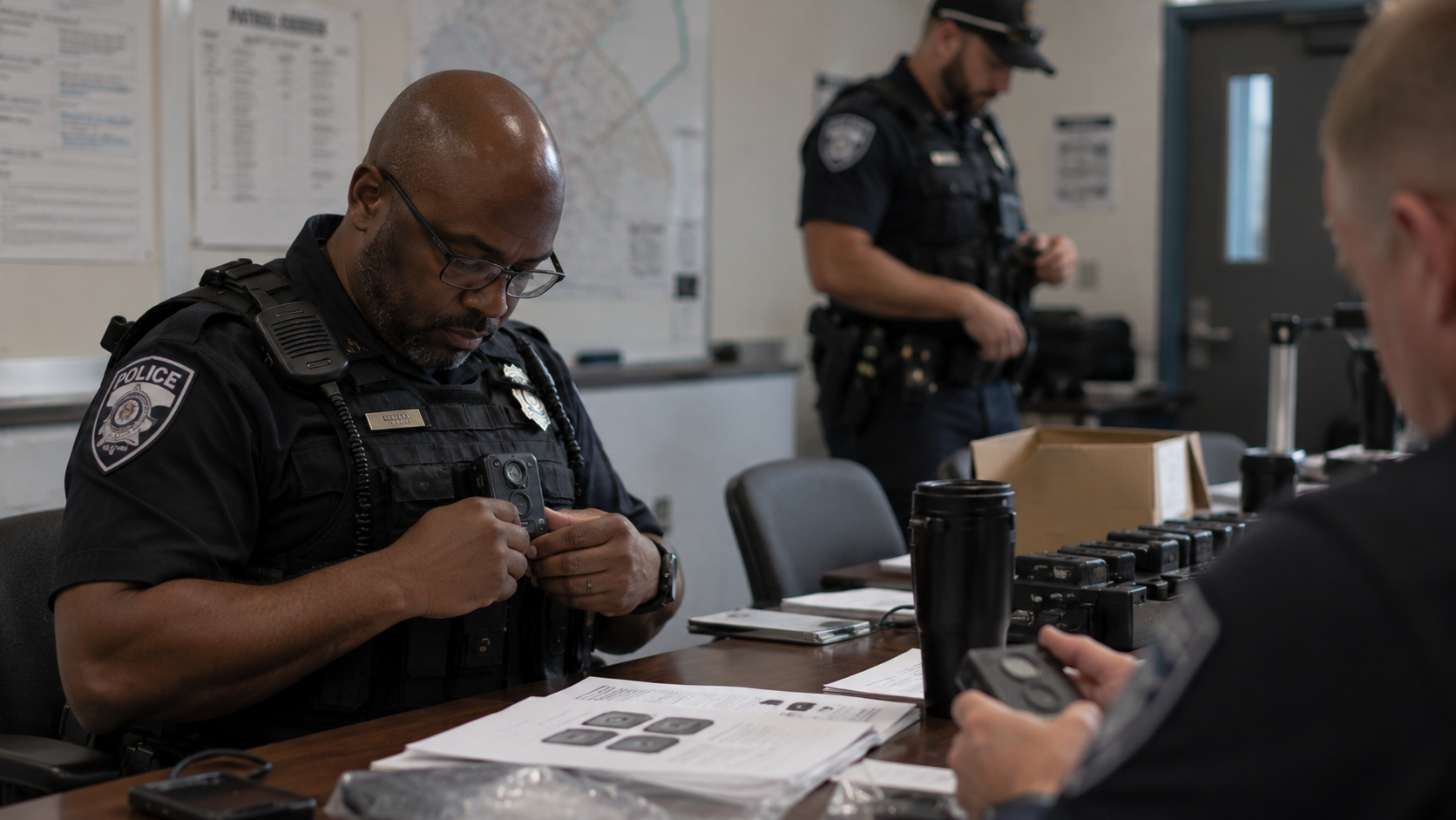
Chief Wiete's advice and the guidance in BJA's toolkit point the same way: have the policy written, distributed, and trained before the cameras go live. Not before the contract is signed. Before the cameras leave the building.
What Policy Training Actually Looks Like Before Day One
A written policy handed to officers is not a trained policy. Officers need to understand it well enough to apply it correctly under pressure at 2am, in the middle of a difficult interaction, when the right answer is not obvious and there is no time to look it up.
The most effective format is scenario-based. Run your officers through a dispatcher-initiated call: the camera activates, the officer handles the interaction, and a supervisor debriefs the activation decision, the classification, and the report alignment afterward. Repeat with a self-initiated stop where manual activation is required. Repeat with a use-of-force event. Make this part of your regular training cycle, not a one-time pre-launch event that gets forgotten by month three.
Apply the same principle to your FOIA process. Your records clerk should not be the only person who knows how to respond to a public records request. Train a backup now. Your state deadline does not adjust for staffing transitions.
Policy is not documentation. It is operational readiness. The department that treats it that way is far better positioned to run a defensible program from the first day cameras go live.
Sources
[1] Colorado Revised Statutes § 24-31-902, Incident recordings: https://law.justia.com/codes/colorado/title-24/principal-departments/article-31/part-9/section-24-31-902/
[2] Indiana Code § 35-44.1-2-2.5, Disabling a Law Enforcement Recording Device: https://law.justia.com/codes/indiana/title-35/article-44-1/chapter-2/section-35-44-1-2-2-5/
[3] Bureau of Justice Assistance, Body-Worn Camera Toolkit, Policy: https://bja.ojp.gov/program/bwc/topics/policy
[4] Bureau of Justice Assistance, Body-Worn Camera Toolkit, National Landscape: https://bja.ojp.gov/program/bwc/topics/national-landscape
[5] National Conference of State Legislatures, Body-Worn Camera Laws Database: https://www.ncsl.org/civil-and-criminal-justice/body-worn-camera-laws-database
[6] Coreforce, "Body Camera Technology for Any Size Agency: Without Adding Staff or Regret" Webinar Transcript, 2026: https://www.coreforcetech.com/resources/body-camera-technology-for-any-size-agency-without-adding-staff-or-regret
Get Your Policy Right Before Cameras Go Live
Let's look at where your policy and technology stand today. Request a consultation with a Coreforce rep who works with agencies like yours.
Your body camera policy isn't finished until it answers the questions a deposition would ask. See what it has to settle before day one.