256px.webp)
Body Cameras in Corrections: Beyond Assumptions, Backed by Results

When corrections leaders evaluate body cameras, they almost always start from one of two places. Believing that body cameras benefit oversight bodies and plaintiff's attorneys more than their own staff - where record that gets used against the department. Or body cameras help but cannot find corrections specific data to justify the investment.
Both positions miss what research shows. Data related to corrections-specific body camera programs is substantial and based on real usage in corrections environments. The question that should be asked is does your facility infrastructure support the technology.
State Corrections Department Data
The most compelling data comes from state correctional departments that deployed programs at scale, measured outcomes, and reported results publicly.
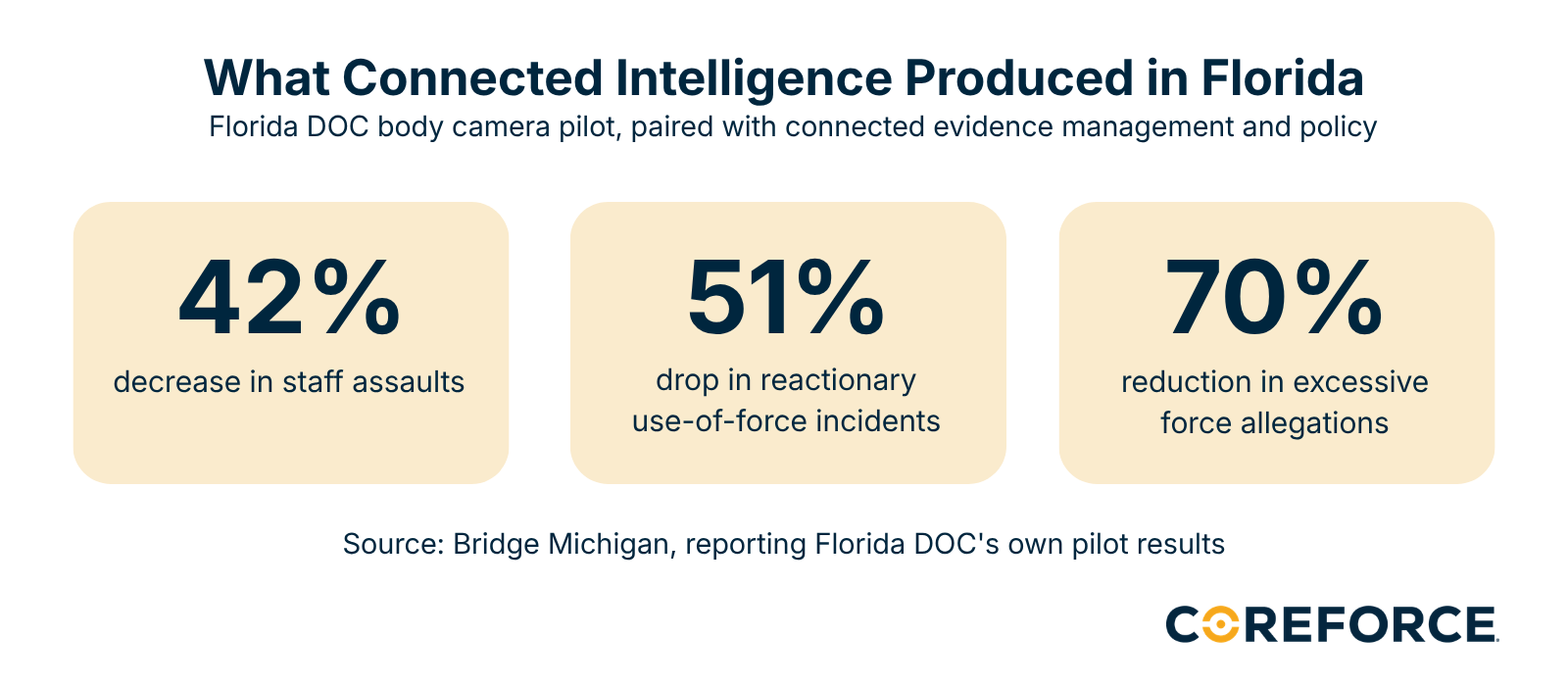
The Florida Department of Corrections launched a body camera pilot in 2019. What their own data showed afterward:
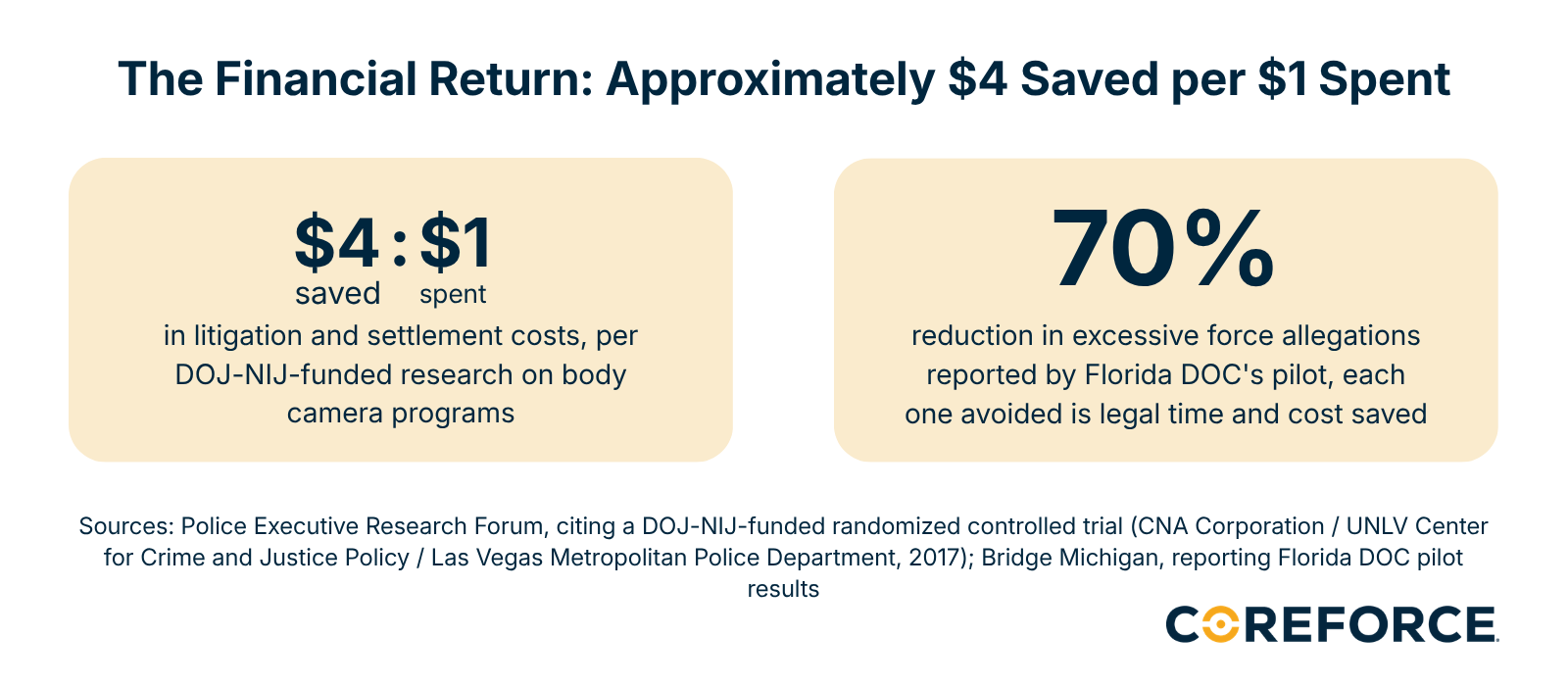
- 70% reduction in allegations of excessive force. [1]
- 51% drop in reactionary use-of-force incidents. [1]
- 42% decrease in staff assaults. [1]
Oklahoma's Department of Corrections piloted body cameras at Oklahoma State Penitentiary and Howard McLeod Correctional Center and reported:
- 40% drop in serious incidents. [2]
- 60% reduction in PREA allegations, a number with direct implications for both staff protection and federal compliance. [2]
These are not incremental improvements. They are results that change budget, staff retention, and liability conversations in the same meeting. Governing bodies that have been asked to fund body cameras for law enforcement have never been shown these numbers from their corrections facilities. That is the argument the data makes.
What Independent Research Confirms
The state-level data shows what happened. The Loudoun County study shows why.
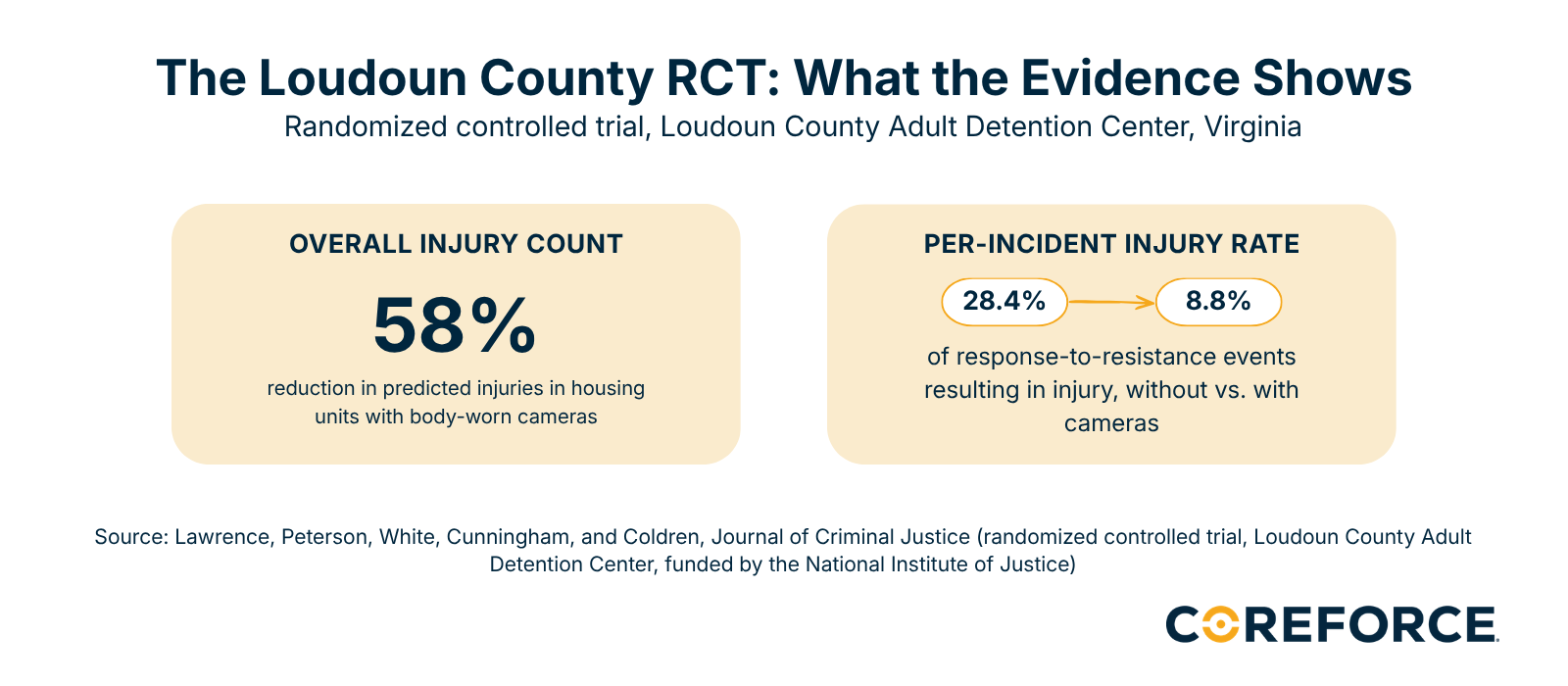
A peer-reviewed randomized controlled trial at the Loudoun County Adult Detention Center in Virginia was funded by the National Institute of Justice and published in the Journal of Criminal Justice. This review studied 12 housing units over one year. Unlike program reports, randomized trial controls were set for population differences, staffing levels, and other variables - so that the outcomes can be specifically associated with the cameras.
- 58% reduction in predicted injuries in housing units where officers were assigned body-worn cameras. [3]
- Injury rates during response-to-resistance events dropped from 28.4% without cameras to 8.8% with cameras. [3]
The 58% reduction is attributable to the cameras. Not to staffing changes. Not to policy changes. Not to anything else that shifted in those housing units at the same time. The cameras yielded the reduction. It is worth noting that this was a single, mid-sized county jail. The study's authors caution that results may may vary, but it remains one of the only rigorous experimental studies of body cameras in a correctional setting to date.
John Boyd shared, per a large statewide corrections system currently deploying body cameras, that one facility within that system has seen inmate-on-staff assaults reduced by 60%, since the deployment began. [4] The pattern is consistent across program type, facility size, and geography - cameras in corrections reduce violence.
Why the Number Are Substantial
The mechanism behind these results is not complicated. Visibility changes behavior before the incident occurs. When a correctional officer is wearing a camera, both the officer and the person they are interacting with know the interaction is being recorded. That knowledge deters escalation on both sides, before the first push, before the first raised voice, before the interaction becomes a use-of-force event.
Boyd frames the equity argument that most governing bodies have never heard:
“Too many funding arms of local governments say it's important to arm police officers with BodyWorn cameras because they're forward-facing. Well, what are correctional officers doing? They're forward-facing every single day, with people that society is afraid of, that judges have determined need to be locked in with other like-minded people. Doesn't it make sense that we arm correctional officers with BodyWorn cameras to help protect them and reduce violent acts against them?”
— Sheriff (Ret.) John Boyd, Coreforce Law Enforcement Relations Manager
The financials reinforce the safety case. A DOJ-funded randomized controlled trial of body cameras in law enforcement found that agencies saved approximately $4 in litigation and settlement costs for every $1 spent on the cameras. This resulted in faster complaint resolution, fewer frivolous claims progressing to litigation, and stronger prosecutorial outcomes.
[5] For a corrections facility managing hundreds of allegations per year, that ratio is not a general statement about cameras. It is a calculation your budget office can run against last year's legal costs.
What’s Not Guaranteed
The evidence is strong. It is not a guarantee that deploying cameras produces these results automatically. The research consistently points to three conditions that separate programs that deliver outcomes from programs that do not.
Policy has to precede deployment. Cameras activated without clear requirements, classification standards, and use-of-force review procedures do not consistently produce the same behavior-change effect. The Florida and Oklahoma numbers reflect programs where policy development happened alongside equipment deployment. The camera without the policy is a recording device. The camera with the policy is a deterrent.
Staff buy-in determines activation consistency. Technology adoption that is announced from above without explanation of how it protects officers, not just how it documents them, will be quietly resisted. Cameras worn incorrectly or deactivated unnecessarily produce neither the safety benefit nor the legal protection. The programs that produced the numbers above invested in explaining the cameras as officer protection tools, not oversight tools.
Connected evidence management determines whether the outcome extends beyond deterrence. A camera that records an interaction and stores the footage in an inaccessible system produces the deterrent effect but loses the downstream legal and operational benefit. The full return - faster complaint resolution, protected officers, defensible records, and the financial benefits - requires the footage to be readily available, linked, and managed in a system built for that purpose.
The facilities that produced the Florida and Oklahoma results deployed cameras as part of a complete program. The camera was the visible piece. The policy, the training, and the evidence management system were the infrastructure that made it work.
Sources
[1] Bridge Michigan — “Michigan to Require Most Prison Staff to Wear Body Cameras” (reporting Florida DOC pilot results: 70% force allegation reduction, 51% use-of-force drop, 42% assault decrease, 2019) https://bridgemi.com/michigan-government/michigan-require-most-prison-staff-wear-body-cameras/
[2] Oklahoma Watch — “Oklahoma Bets on Body-Worn Cameras to Improve Prison Conditions” (reporting ODOC pilot: 40% drop in serious incidents, 60% PREA reduction, per ODOC spokesperson Kay Thompson) https://oklahomawatch.org/2024/10/02/oklahoma-bets-on-body-worn-cameras-to-improve-prison-conditions/
[3] Lawrence, Peterson, White, Cunningham, and Coldren — “Can Body-Worn Cameras Reduce Injuries During Response-to-Resistance Events in a Jail Setting?” Journal of Criminal Justice (randomized controlled trial, Loudoun County Adult Detention Center, NIJ Award No. 2018-75-CX-0019) https://www.crimrxiv.com/pub/ucvemc94/release/1
[4] Coreforce, “Building a Defensible Foundation: Intake, Documentation & Data Integrity” Webinar Transcript, 2026 https://www.coreforcetech.com/resources/building-a-defensible-foundation-intake-documentation-data-integrity
[5] Police Executive Research Forum — “Body-Worn Cameras a Decade Later: What We Know,” December 2023, citing a DOJ-NIJ-funded randomized controlled trial (CNA Corporation / UNLV Center for Crime and Justice Policy / LVMPD, 2017) https://www.policeforum.org/assets/BWCdecadelater.pdf
The Camera Is Only the Visible Piece
See the Coreforce BODYWORN™ cameras and ecosystem at work in corrections, benefiting your facility.
Do cameras help plaintiffs more than staff? Is there any corrections-specific data? See what state pilots and a randomized trial found.