256px.webp)
The Incident Record Still Won't Hold Up. Here's Why.

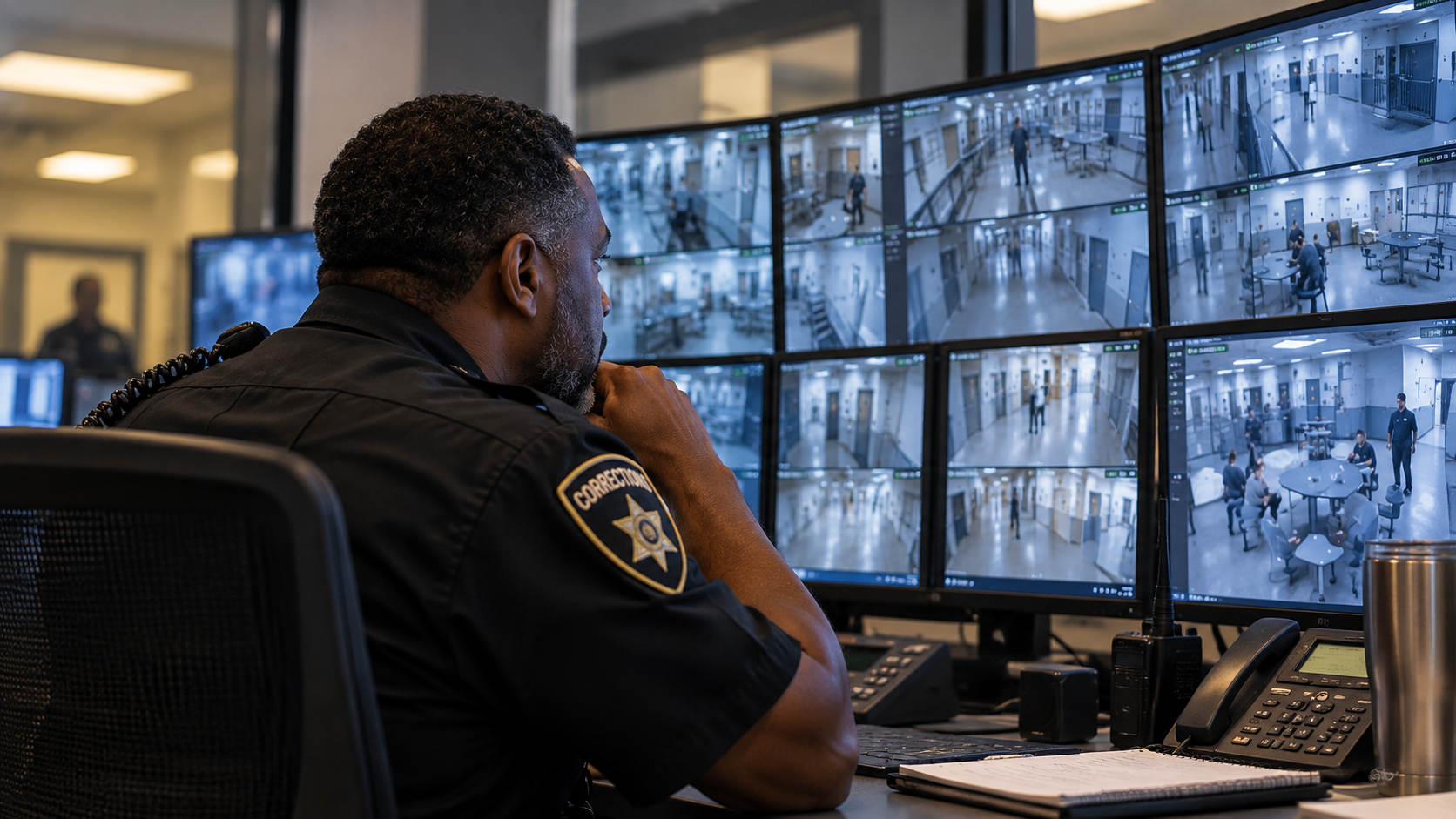
The documentation exists. After a serious incident in your facility, your staff will spend the next several days assembling a record. They will pull video from the fixed camera system. Cross-reference with the paper incident report. Check the Jail Management System (JMS) for the individual's housing history. Pull medical notes from a separate system. Look for prior behavioral flags in a database that does not talk to any of the others. Then stitch it into something coherent enough to give to an attorney, an investigator, or an oversight body.
When that assembled record contains gaps, conflicting information, or inconsistent timestamps, it does more than appear disorganized. It raises questions about whether the facility had a clear understanding of what occurred. In litigation, that uncertainty can undermine the credibility of the entire record.
This is not simply a documentation compliance issue. It's a documentation design issue. Officers are documenting their work. The problem is that the systems they're using were never designed to create a complete, defensible record.
The Reality of Disconnected Systems
“Disconnected systems” may sound like an IT problem. It's an operational problem your officers experience every shift.
John Boyd travels the country working with correctional leaders. The facility he describes below is not an outlier. It's a scenario he sees time and again.
“I know of an agency that has at least six different siloed servers that don't communicate with each other. To gather mental health information, they have to go to another floor. For health care, another wing. For nutritional information, the kitchen. They have a handwritten receipt book for property. Everything is siloed and none of those systems communicate. And that's where things get lost.”
— Sheriff (Ret.) John Boyd, Coreforce Law Enforcement Liaison
Boyd's example is about what happens inside a single facility during a single shift. The same basic problem shows up even in the simplest cross-agency task: getting a record to someone outside the building. A national survey of state corrections departments found that when it comes to something as routine as sending a medical record to an outside provider, the overwhelming majority still rely on mail or fax. Only a small fraction can do it through an actual electronic record system. [1]
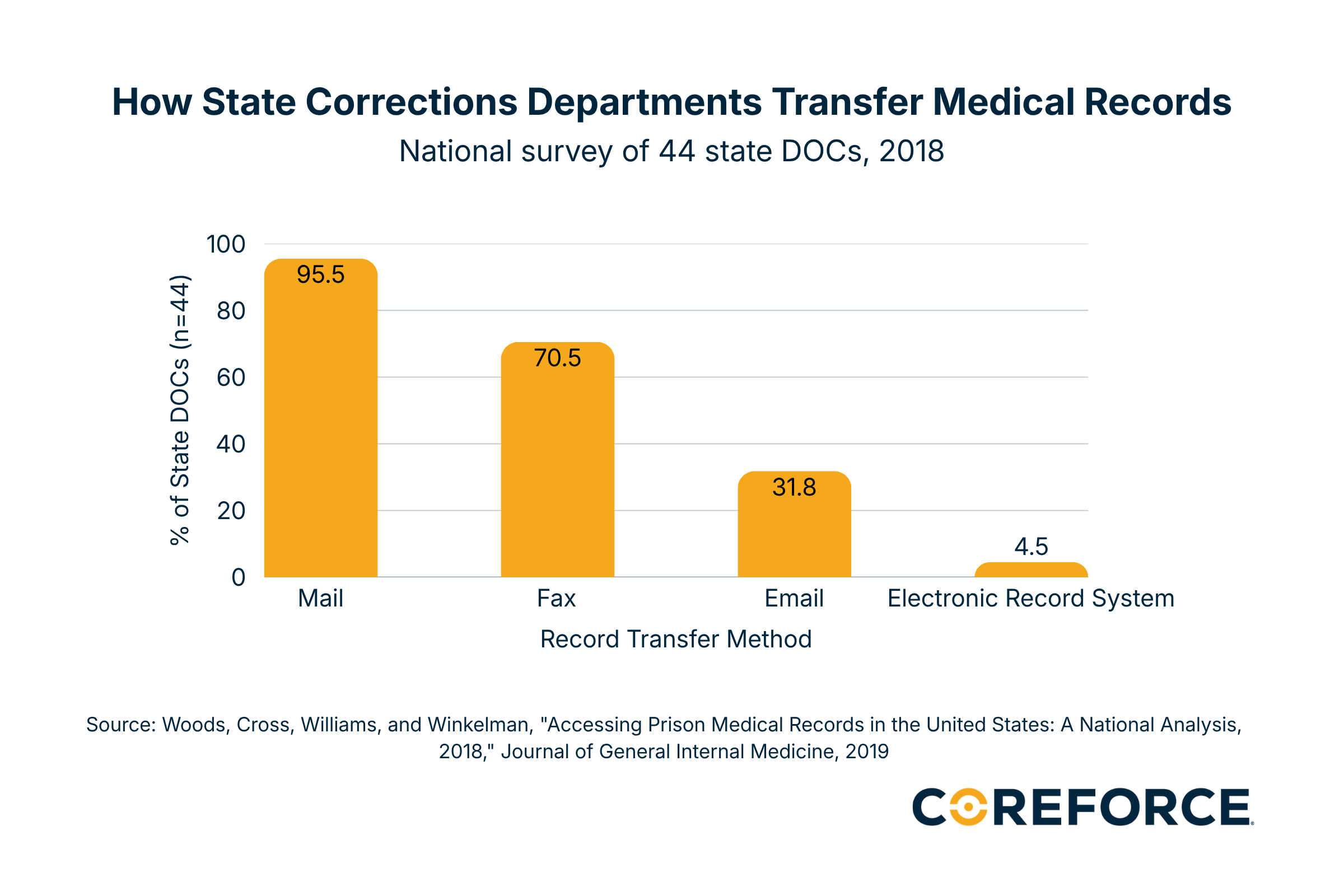
That's a narrower slice of the problem than the one Boyd describes, it's about records leaving the facility, not the day-to-day scramble between siloed systems inside it. But it's a useful data point for a simple reason: if even the most basic, most external record-sharing task still runs on mail and fax at most agencies, it says something real about how far behind the underlying infrastructure is, the same infrastructure officers are relying on internally, every shift, under far more time pressure than a reentry records request.
Run that same scenario on a short-staffed shift. Instead of supervising a housing unit, an officer is moving between locations and systems to piece together information that should be available in a single place. While that officer is checking food allergy records in the kitchen, the housing unit is left with less direct supervision. What appears to be an inefficient workflow is actually an operational vulnerability. Every unnecessary trip, duplicate search, or disconnected process takes an officer away from where they're needed most.
The Record That Defends – or Doesn't
The real cost of fragmented systems is not during the incident. It's after.
Josh Tewalt, former Director of the Idaho Department of Corrections, had 25,000 people under supervision. His description of post-incident review in a fragmented system is the most operationally honest account of this problem.
“You have people with limited bandwidth trying to gather information across multiple systems where it may or may not live. Pulling video from fixed cameras in a different system and somehow attaching that to paper incident reports, then attaching that to other evidence, then attaching that to profiles on the people involved that live in an entirely different system. The effort to put together a paper trail for review far outlives any time spent in the incident itself. And all of that takes valuable staff time away from people that we would rather be spending doing other things.”
— Josh Tewalt, Former Director, Idaho Department of Corrections
That assembly process has three direct consequences that compound each other.
Time. In an understaffed facility, the time spent gathering information from multiple disconnected systems is time taken away from supervising units and supporting frontline staff.
Accuracy. Information assembled after the fact from multiple systems is not a record of what happened. It is a reconstruction of what happened. Timestamps may not align. Details may be remembered differently from how they were documented at the time. The reconstruction process introduces error and inconsistency that becomes visible under legal scrutiny.
Liability. A fragmented, reconstructed record is harder to defend than one built in real time. Corrections litigation nationally is a genuinely large and growing cost center for state budgets, and a record with gaps, inconsistent timestamps, or conflicting entries gives opposing counsel an opening that a clean, real-time record does not. That's not a hypothetical: it's the exact scenario Tewalt describes above, staff assembling a defense after the fact, rather than starting from a record that was already complete.
What a Defensible Record Actually Requires
A unified record does not just satisfy a legal standard. It changes what an investigation looks like for your facility.
“A unified record is relatively seamless and can be presented more logically. It is systematic and therefore more professional. A professional investigation is notable to prosecutors, to judges, to juries, to attorneys, and to the public. It allows correctional facilities to be more transparent and highly regarded.”
— Sheriff (Ret.) John Boyd, Coreforce Law Enforcement Liaison
That professionalism is not cosmetic. A record that tells a clear, chronological story from the moment of the incident through every response action is easier to understand, easier to defend, and faster to review. It can reduce the time staff spend preparing for depositions, strengthen the facility's legal position, and in some cases discourage claims before they're ever filed.
The facilities building this kind of record are not doing it by asking their officers to document more. They are doing it by giving officers systems that create the record at the moment of the interaction rather than after it. Systems where the video, the report, the individual's profile, and the facility's response are part of the same connected file, rather than separate artifacts that have to be assembled by hand.
Where to Start
The audit with the most impact is the one you do on your current workflow, not a technology audit, a human audit. Ask your supervisors how many systems they log into during a single shift. Ask your officers where they lose time during documentation. Ask your investigations team how long it takes to pull a complete incident record after a use-of-force event.
Those answers will tell you where your highest-risk gaps are and which ones can be closed without a full technology overhaul. Not every facility needs to rebuild everything at once. However, every facility needs to know where its record is indefensible before a deposition happens.
Sources
[1] Woods GT, Cross K, Williams BC, Winkelman TNA — “Accessing Prison Medical Records in the United States: A National Analysis, 2018,” Journal of General Internal Medicine 34(11):2331–2332, 2019 https://doi.org/10.1007/s11606-019-05137-w
[2] Coreforce, “Building a Defensible Foundation: Intake, Documentation & Data Integrity” Webinar Transcript, 2026 https://www.coreforcetech.com/resources/building-a-defensible-foundation-intake-documentation-data-integrity
[3] Coreforce, “Intelligence Inside the Facility: Increasing Safety Without Increasing Staffing” Webinar Transcript, 2026 https://www.coreforcetech.com/resources/intelligence-inside-the-facility-increasing-safety-without-increasing-staffing
Hear What It Costs When Documentation Lags
Sheriff (Ret.) John Boyd and former Idaho DOC Director Josh Tewalt discuss what a defensible record looks like when it ends up under scrutiny.
The problem isn't that officers fail to document. It's that their systems were never built to produce a defensible record. See what that record requires.