256px.webp)
What Makes Footage Hold Up in Court — and What Can Get It Thrown Out

Every chief evaluating body cameras is ultimately trying to answer one question: when this footage matters most, will it hold up?
Not in an ideal scenario. In the scenario where a defense attorney has had six months to find every weakness in your department's evidence handling. In the scenario where a judge has to decide whether to admit footage that your agency's ability to prosecute a case depends on. In the scenario where an officer's career, the department's credibility, and the outcome of a serious case all turn on whether the footage in your DEMS is legally defensible.
The answer is yes, body camera footage holds up when it is handled correctly. And no, it does not when it is not. The difference between the two is not the camera. It is the chain of custody, the classification, the metadata, the policy, and the system that manages all of them.
What Courts Actually Require to Admit Footage
Body camera footage is not automatically admissible. Courts require it to meet specific standards before it comes in as evidence, and defense attorneys know exactly where to attack those standards. Understanding what courts look for is the first step to ensuring your footage consistently meets the threshold.
The Virginia Supreme Court addressed this directly in December 2024 in Baez v. Commonwealth, finding that body camera footage “is not inherently a testimonial statement” and can be admitted without the recording officer testifying, but only when the agency can establish an adequate foundation for the accuracy of the process that produced it. [1] The court was explicit: authentication is one part of the admissibility analysis, and other evidentiary rules can still exclude footage depending on how it is offered. Getting footage past authentication does not guarantee admissibility.
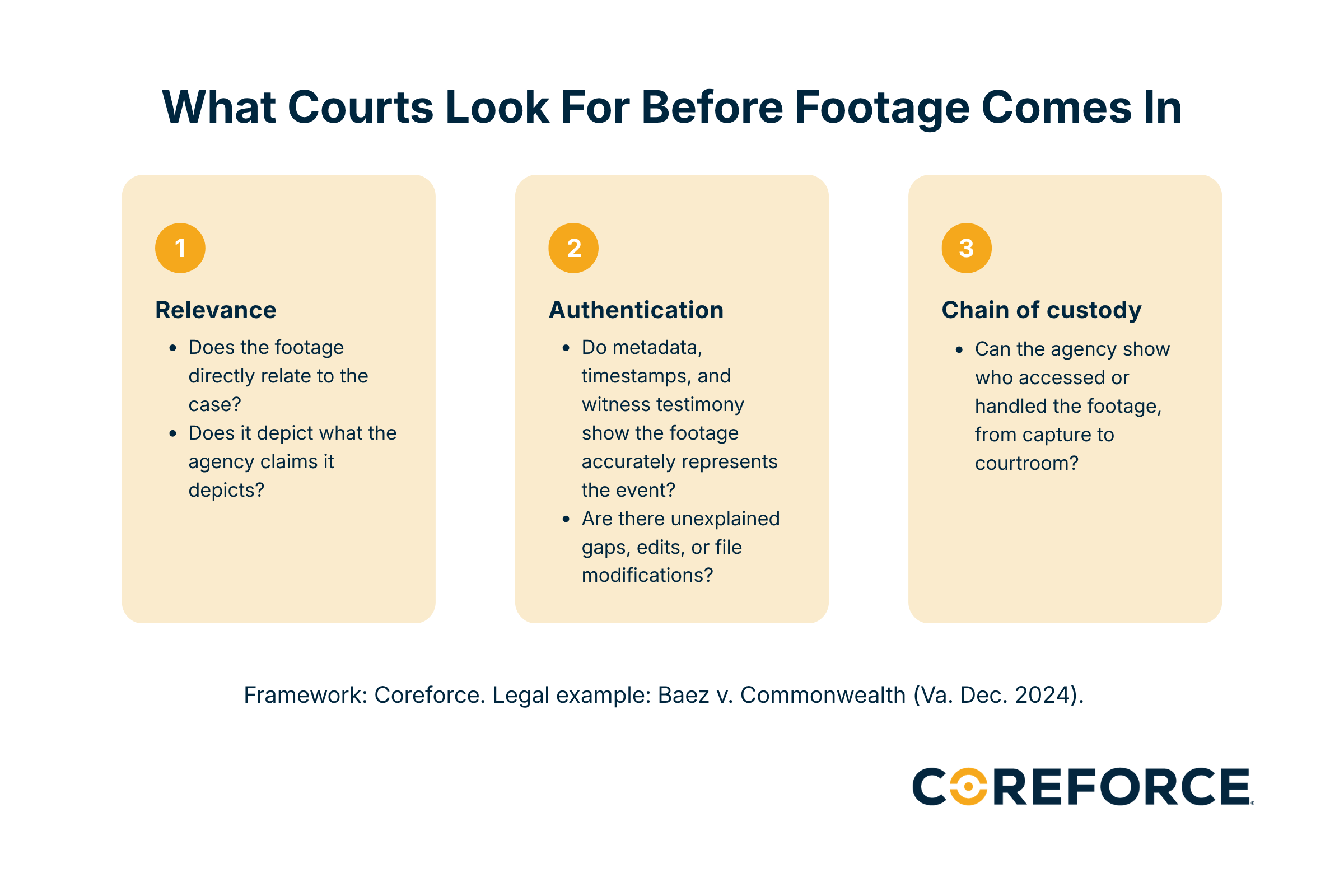
For most small agencies, footage needs to satisfy three core requirements before a judge will allow it in.
Relevance. The footage must directly relate to the case and depict what it is claimed to depict. This is rarely the issue for departments with camera programs.
Authentication. The court must be satisfied that the footage accurately represents what actually occurred. This is established through officer testimony, through metadata and timestamps embedded in the file, or through both. Any gap, inconsistency, or sign of alteration puts authentication at risk. [2]
Chain of custody. The department must prove that the footage has not been tampered with, altered, or accessed by unauthorized parties from the moment of capture to the moment it is presented in court. Any undocumented handoff, any gap in the access log, any unexplained modification to the file is a chain of custody vulnerability that a defense attorney will use. [3]
The Four Ways Footage Gets Challenged — and What Causes Each One
Defense attorneys challenging body camera footage use a limited set of attack vectors. They work because they target specific failure points in how small agencies manage evidence. Every one of them is preventable.
Gaps in the recording. If an officer deactivates the camera during an interaction, or the camera fails to activate for a self-initiated stop, the missing footage becomes a question the defense will ask in front of a jury. In some states, it becomes more than a question: Colorado law creates a permissive inference of officer misconduct when a camera is not activated during certain events. [4] Missing footage is not just an evidentiary gap. In the right jurisdiction, it is a liability.
Gaps in the chain of custody. Every person who accesses the footage from capture to courtroom needs to be logged. Every transfer needs documentation. If footage moves from an officer's camera to a department server to a prosecutor's office without a complete, audited access record, a defense attorney will argue the file could have been altered along the way. Courts do not need proof of tampering to exclude footage. They need doubt about the integrity of the handling process. [3]
Metadata inconsistencies. Timestamps embedded in the video file need to match the officer's report, the CAD record, and the arrest report. When they do not, even by a few minutes, the inconsistency becomes a discrepancy the defense will point to. Footage exported in a format that strips metadata, or transferred in a way that modifies file timestamps, can undermine authentication even when nothing was actually altered.
The footage contradicts the report. When an officer's written incident report does not align with what the footage shows, the credibility problem belongs to the department, not the defense. Chief Wiete described exactly this risk: prosecutors in her county read the report before they review the footage, and if the two do not align, it is a problem that follows the case through trial.
“You might think you said or did something and then you go back and look at your video and it's different. There could be a discrepancy. And if the prosecutor is reviewing it and it doesn't line up with what the report says versus what the video shows, that is an issue.”
— Chief Lesley Wiete, Purdue University Police Department
What a DEMS Does That a Shared Drive Cannot
Every one of the attack vectors above is directly addressed by how a department's evidence management system works. This is the operational connection between the system you choose and the courtroom outcome you are trying to achieve.
A shared drive, a physical DVD, or an unmanaged file server can hold footage. It cannot produce an unbroken, court-ready chain of custody log. It cannot preserve the original metadata from capture through every access and transfer. It cannot demonstrate to a judge that the file you are presenting in court is identical to the file that came off the officer's camera six months ago.
A DEMS built for law enforcement does all of this by design. Every access is logged automatically with a timestamp and a user credential. Every transfer creates an audited record. The original file is preserved in its native format with all metadata intact. When a defense attorney asks who accessed the footage and when, the answer is a complete log, not a search through email threads and shared folder permissions.
“With these audit trails, it can actually prove that you provided it, that they received it, and in cases, that they actually opened it as well.”
— Chief Mark Swistek, Long Beach (IN) Police Department
Why the Report and the Footage Have to Tell the Same Story
The most common courtroom problem for small agencies with body cameras is not a legal technicality. It is an operational one. The officer wrote the report from memory. The footage captured something different. The defense found it.
Prosecutors in most small jurisdictions build their case on the written report first. They look at the footage to confirm it, not to discover it. When the footage contradicts a detail in the report, even a minor one, it is a credibility problem for the officer and for the case.
Officer review before report writing is the practice that prevents this. It is not about changing what happened. It is about ensuring the written account of what happened matches the objective record of what happened. When both tell the same story, the footage is a strength. When they diverge, the footage becomes a weapon the other side uses.
This is why Wiete's prosecutors read the report before they look at footage. If the report is wrong, the footage does not help. It proves the report is wrong. Building the habit of officer review into your department's workflow before cameras go live is the single most practical step available to prevent this problem.
The Question to Ask About Every System You Evaluate
When you are comparing body camera systems, the courtroom question cuts through every features comparison. Ask the vendor: if this footage is challenged in court six months from now, what does your system produce to establish chain of custody?
The correct answer is a complete, automatically generated access log showing every person who viewed, transferred, or modified the file from the moment it was created, with timestamps, user credentials, and file integrity verification. That log should be producible in minutes, not assembled from multiple sources by someone who has to search for it.
If the vendor cannot articulate what the log looks like and how its generated; most likely, the footage produced will not muster up to the standards set by the judge presiding over the case in question.
Chief Andrew McIntyre of the Valparaiso (IN) Police Department, a nearly decade-long Coreforce partner, described exactly this kind of test: an active shooter incident that escalated into a running gun battle through the city. Synchronized body-worn and in-car video captured the encounter from start to finish, and because it was fully documented, independent investigators and prosecutors had immediate, shared access to the same evidence.
“Video doesn't lie. It captured everything and told the whole story for us. The reliability and confidence in our Police Department has continued to grow with easy access to footage by officers, supervisors, and prosecutors. Complaint resolution is completed in a sensible time frame, confirming facts of the incident and appropriate officer conduct. We've been a partner with Coreforce for close to 10 years. I wouldn't trade it for anything.”
— Chief Andrew McIntyre, Valparaiso (IN) Police Department
Sources
[1] Blankingship & Keith — Baez v. Commonwealth, Virginia Supreme Court, December 19, 2024 (body camera footage authentication and Confrontation Clause) https://www.blankingshipandkeith.com/news-insights/the-supreme-court-determines-the-admissibility-of-an-officers-body-worn-camera-footage
[2] StechLaw Criminal Defense — Body Worn Cameras as Evidence: What to Know (authentication via metadata and timestamps) https://www.tpatrialattorneys.com/body-worn-cameras-evidence-florida/
[3] FocalForensics — Video Evidence Chain of Custody Checklist (chain of custody requirements, court-ready documentation) https://focalforensics.com/blog/video-evidence-chain-of-custody-checklist
[4] CriminalDefenseLawyer.com / Nolo — Police Body Camera Laws and Policies (Colorado permissive inference of misconduct for failure to activate) https://www.criminaldefenselawyer.com/resources/police-body-camera-laws-and-policies.html
[5] Coreforce Case Study — “Modern Tools for Modern Policing: Valparaiso Police Secures Court-Ready Evidence with Comprehensive Video Documentation,” quoting Chief Andrew McIntyre
https://www.coreforcetech.com/resources/modern-tools-for-modern-policing
[6] Coreforce, Body Camera Technology for Any Size Agency: Without Adding Staff or Regret Webinar Transcript — Chief Mark Swistek, Chief Lesley Wiete, 2026
Can Your System Prove Its Own Chain of Custody?
See how Coreforce's digital evidence management system (DEMS) produces a complete chain of custody record for every piece of footage your department captures.
Every chief weighing body cameras asks the same thing: will the footage survive a defense attorney? See what courts look for.